| 2026 | A wall-based, interpretable reduced-order model for real-time estimation of near-wall turbulence
Pérez Cuadrado, Cavallazzi, Nóvoa and Pinelli | Under review | |
| 2026 | Transferable inference of turbulence models for urban flows with the Parameter-Regularised Ensemble Kalman Filter
Bombardi, Nóvoa, Magri and Parente | Under review | |
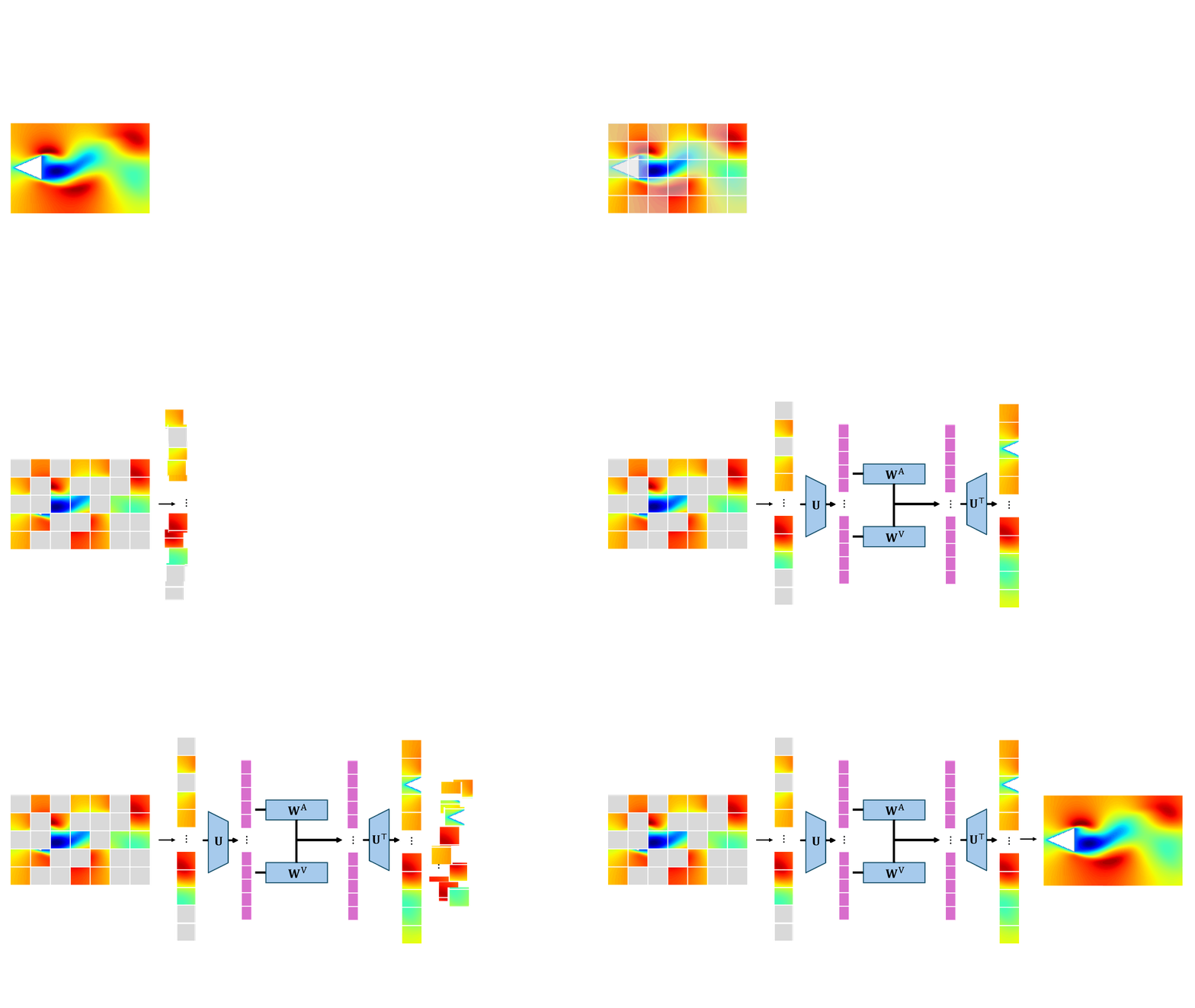
| 2026 | Latent attention on masked patches for flow reconstruction
Eze, Magri and Nóvoa | ICCS Lecture Notes in Computer Science
Workshops, pp. 181–188 | |
| 2026 | Efficient adaptation of ROMs for unsteady flows using data assimilation
Zighed, Nóvoa, Magri and Sayadi | Computers & Fluids
107250 | |
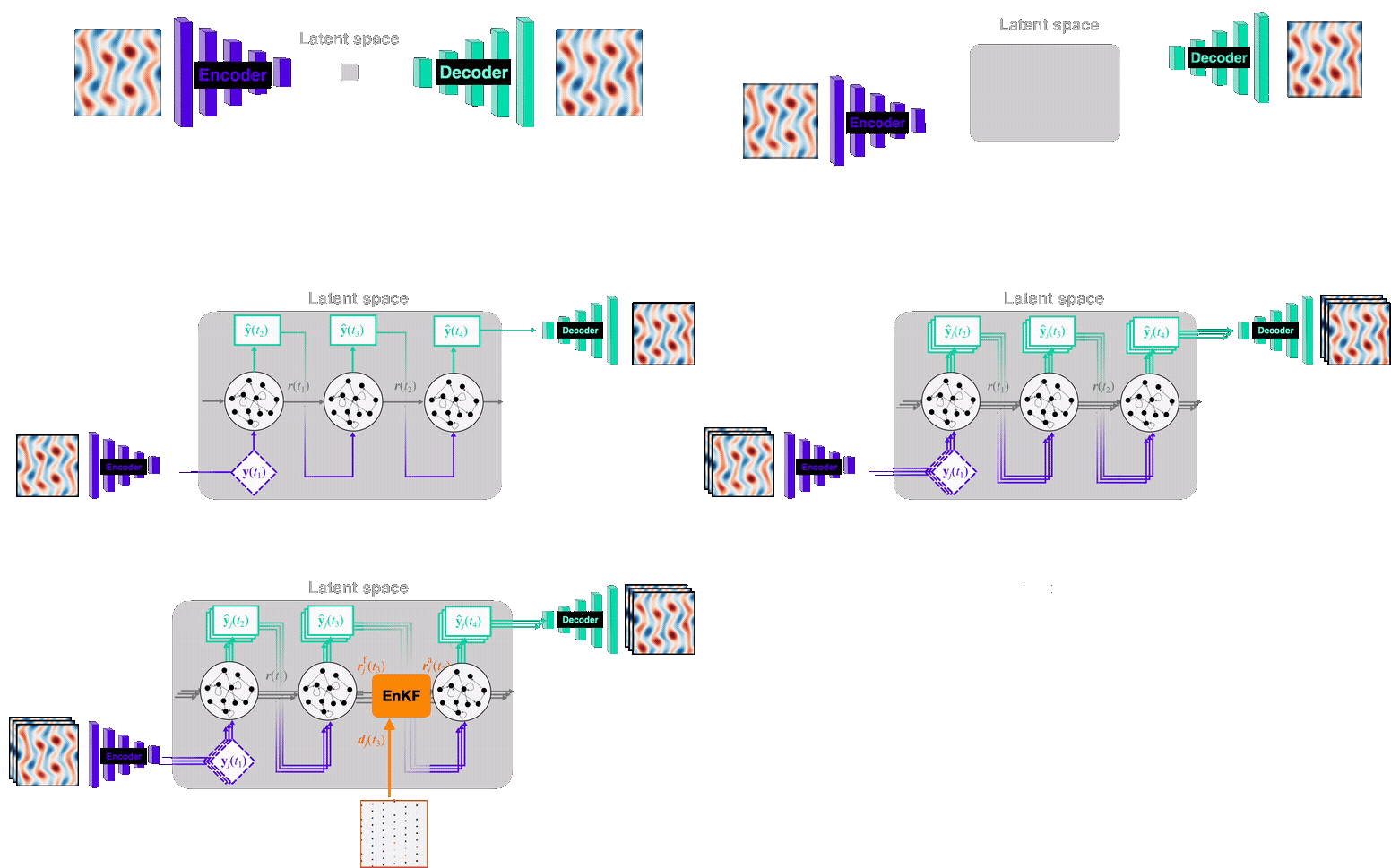
| 2026 | Real-time forecasting of chaotic dynamics from sparse data and autoencoders
Özalp, Nóvoa and Magri | Computer Methods in Applied Mechanics and Engineering
450, 118600 | |
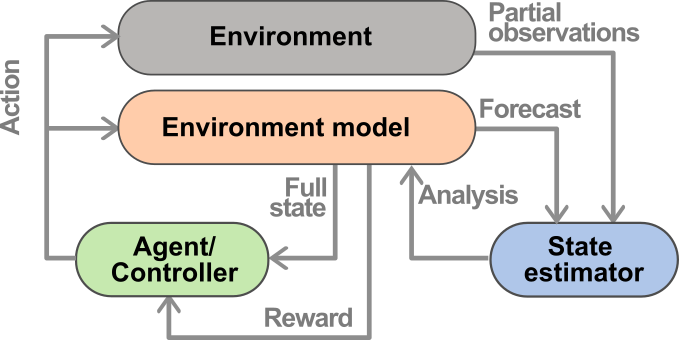
| 2025 | Data-assimilated model-informed reinforcement learning
Ozan, Nóvoa, Rigas and Magri | Proc. of the Royal Society A
481(2327): 20250476 | |
| 2025 | Online model learning with data-assimilated reservoir computers
Nóvoa and Magri | ICCS Lecture Notes in Computer Science
Vol. 15910, pp. 57–64 | |
| 2025 | Data-assimilated model-based reinforcement learning for partially observed chaotic flows
Ozan, Nóvoa and Magri | ICCS Lecture Notes in Computer Science
Vol. 15910, pp. 65–72 | |
| 2024 | Real-time digital twins of multiphysics and turbulent flows
Nóvoa and Magri | Proceedings of the Center for Turbulence Research Summer Program
pp. 207-216 | |
| 2024 | A real-time digital twin of azimuthal thermoacoustic instabilities
Nóvoa, Noiray, Dawson and Magri | Journal of Fluid Mechanics
1001, A49 | |
| 2024 | Prediction of chaotic dynamics from data: An introduction
Magri, Nóvoa and Özalp | Book chapter in: Machine Learning for Fluid Mechanics
Ed. by M. A. Mendez and A. Parente, von Karman Institute for Fluid Dynamics, 2025 | |
| 2023 | Inferring unknown unknowns: regularized bias-aware ensemble Kalman filter
Nóvoa, Racca and Magri | Computer Methods in Applied Mechanics and Engineering
418, 116502 | |
| 2022 | Real-time thermoacoustic data assimilation
Nóvoa and Magri | Journal of Fluid Mechanics
948, A35 | |
| 2022 | Bias-aware thermoacoustic data assimilation
Nóvoa, Racca and Magri | Proceedings of the 51st InterNoise Conference
pp. 1924-1931(8) | |
| 2021 | Fully automated methodology for the delineation of railway lanes and the generation of IFC alignment models using 3D point cloud data
Soilán, Nóvoa, Sánchez-Rodríguez, Justo and Riveiro | Automation in Construction
126, 103684 | |
| 2020 | Semantic segmentation of point clouds with PointNet and KPConv architectures applied to railway tunnels
Soilán, Nóvoa, Sánchez-Rodríguez, Riveiro and Arias | The International Archives of the Photogrammetry, Remote Sensing and Spatial Information Sciences
V-2-2020, pp. 281-288 | |