Validation strategies
Hyperparameter selection in train() minimizes a validation
objective by Bayesian optimization. The objective is pluggable: any function in
echostatenetwork.validation can be passed as
train(validation_strategy=...). They differ in how the wash-train-validation
series is folded into training and validation intervals — everything else
(closed-loop scoring, the Tikhonov grid, the optimizer bookkeeping) is shared.
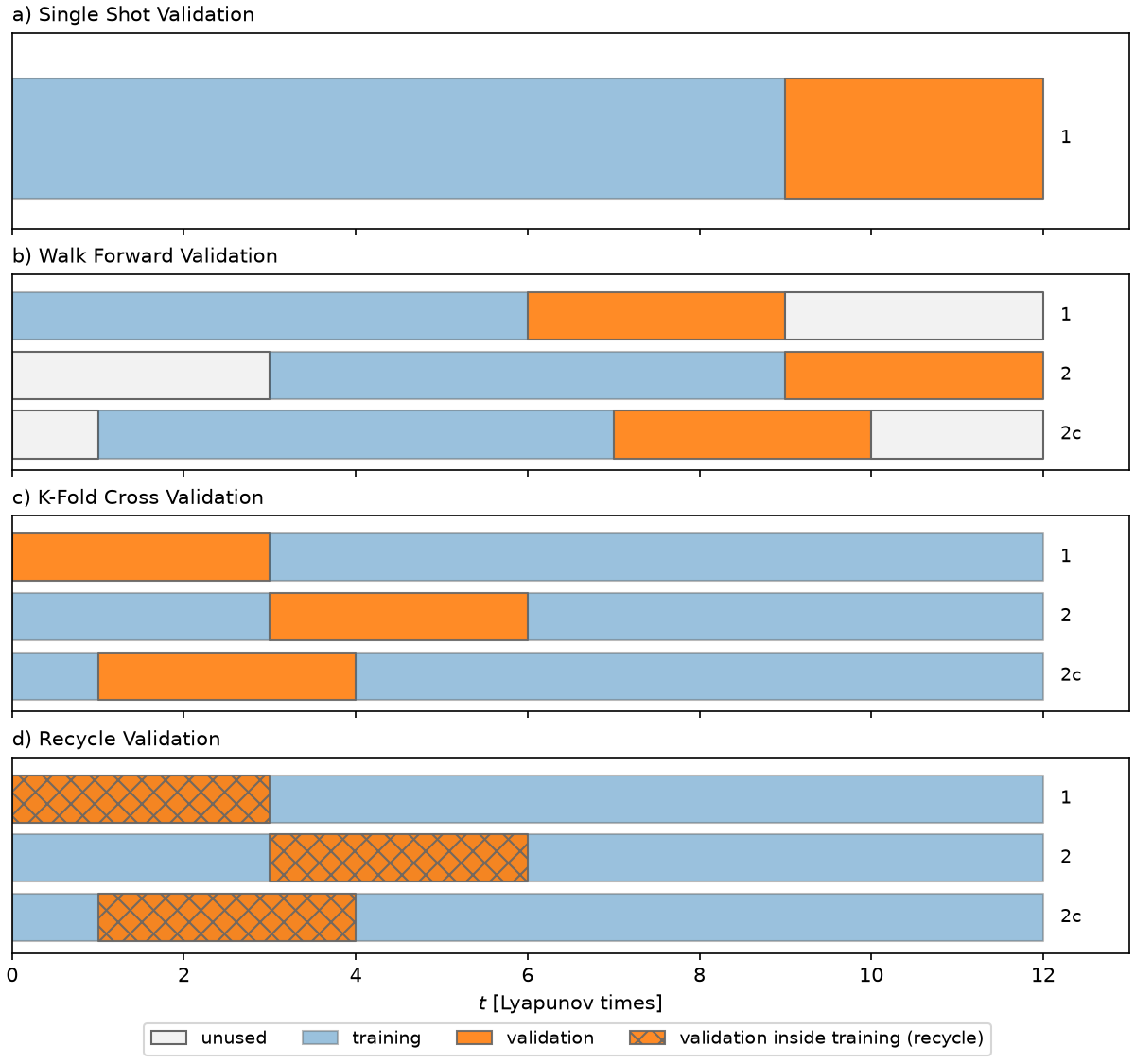
Fold geometry on a 12-Lyapunov-time series, redrawn after Fig. 2 of Racca &
Magri (2021). Rows 1 and 2 are successive folds of the regular version; row 2c
is the chaotic variant, which advances folds by about one Lyapunov time instead
of the interval length so the intervals overlap and the fold count multiplies
(set val_fold_step). Hatched = validation intervals recycled from inside the
training data.
Choosing a strategy
RVC_Noise(the default) — chaotic recycle validation.Woutis trained once on all the data; each fold only re-washes the reservoir and scores a closed-loop run on an interval recycled from the training series. Racca & Magri (2021) find it matches K-fold's accuracy at a fraction of the cost, since there is no per-fold retraining.SSV— single shot validation: one training/validation split. The cheapest and, for chaotic series, the least reliable — its single interval correlates weakly with test error. Provided for comparison.WFV— walk forward validation: a fixed training window slides forward, validating on the interval just after it; each fold retrainsWouton its own window (pure arithmetic on prefix ridge sums — the open-loop reservoir pass is shared).KFV— K-fold validation: leave-one-interval-out; each fold retrains on everything outside its validation interval, exactly (prefix-sum assembly), and validates on it.
All strategies select the Tikhonov parameter from tikh_range per evaluation
and score their probes through a shared validation metric: any callable
metric(case, Y_true, Y_pred, norm) -> float (divergence penalty included).
Set validation_metric on the ESN to swap the scoring for every strategy at
once; built-ins are log_nMAE (log10 range-normalized MAE, the recycle-family
default) and nMSE (raw variance-normalized MSE). The qlESN-specific segment
strategies (SegmentRVC_Noise, RecycledSegmentRVC_Noise) live in
qlrom's
qlroms.data_driven_qlroms.validation and share the same contract.
Ensembles of reservoir seeds
The reservoir matrices are random draws, so validation quality is an ensemble
statement. train(n_seeds=m) trains m realizations in parallel, keeps the
one with the best validation score, and stores all scores in seed_scores.
scripts/compare_validation_strategies.py
reproduces the paper's Table-1/Figure-8 protocol at reduced scale and evaluates
that selection rule: the kept member consistently lands in the ensemble's best
half on test error, usually the best quarter.
See the validation strategies tutorial for a live comparison on Lorenz 63.
Reference
Racca & Magri (2021). Robust optimization and validation of echo state networks for learning chaotic dynamics. Neural Networks, 142, 252-268 (arXiv:2103.03174).
API
echostatenetwork.validation
Validation strategies for EchoStateNetwork's Bayesian hyperparameter search.
Plain functions with the shared signature
(x, case, U_wtv, Y_wtv, tikh_opt, hp_names, print_convergence): case is the
EchoStateNetwork being validated, x the hyperparameter values under evaluation.
Pass one as train(validation_strategy=...); the class aliases
(EchoStateNetwork._RVC_Noise etc.) keep the old spelling working.
- RVC_Noise: chaotic recycle validation, within-segment folds (the default).
- SSV / WFV / KFV: the single-series strategies of Racca & Magri (2021), sharing the single_series_validation engine (one open-loop pass, prefix-sum ridge).
The qlESN-specific segment strategies (SegmentRVC_Noise, RecycledSegmentRVC_Noise) live in qlroms.data_driven_qlroms.validation -- they exist for ragged dwell-segment corpora, not for this package's single/regular series.
VALIDATION METRICS are shared across strategies: a metric is any callable
metric(case, Y_true, Y_pred, norm) -> float scoring one closed-loop probe
(divergence penalty included). Every strategy uses case.validation_metric
when set, else its own default. Built-ins: log_nMAE (log10 range-normalised
MAE, the recycle-family default) and nMSE (raw variance-normalised MSE).
log_nMAE(case, Y_true, Y_pred, norm=1.0)
Probe metric: log10 of the range-normalised MAE; a diverged probe scores a fixed +10 instead of poisoning the accumulated sum. The default of the recycle-validation family.
Source code in echostatenetwork/validation.py
27 28 29 30 31 32 | |
nMSE(case, Y_true, Y_pred, norm=None)
Probe metric: raw MSE normalised by the truth's own mean square (norm is
ignored); 1e6 for a diverged probe. A common open-loop one-step objective,
usable in any strategy via case.validation_metric.
Source code in echostatenetwork/validation.py
35 36 37 38 39 40 | |
unstable(case, U_wtv, Y_wtv, Wout_tik)
1.0 for each Tikhonov candidate whose closed loop of stability_steps steps, after a
washout at the start of the first segment, leaves the attractor (non-finite, or beyond
3x the largest |y| of the data) or whose output standard deviations leave
stability_band times those of the data; else 0.0. The gate of RVC_Noise.
Source code in echostatenetwork/validation.py
44 45 46 47 48 49 50 51 52 53 54 55 56 57 58 59 60 61 62 63 64 65 66 67 68 | |
RVC_Noise(x, case, U_wtv, Y_wtv, tikh_opt, hp_names, print_convergence=True)
Implements Chaotic Recycle Validation for hyperparameter optimization.
Parameters:
| Name | Type | Description | Default |
|---|---|---|---|
x
|
list
|
Hyperparameter values to evaluate. |
required |
case
|
EchoStateNetwork
|
Instance of the ESN being validated. |
required |
U_wtv
|
ndarray
|
Wash-train-validation input data. |
required |
Y_wtv
|
ndarray
|
Corresponding labels for train/validation data. |
required |
tikh_opt
|
ndarray
|
Array to store optimal Tikhonov regularization values. |
required |
hp_names
|
list
|
Names of the hyperparameters being optimized. |
required |
Returns:
| Type | Description |
|---|---|
float: Mean (over folds) log10 closed-loop normalized MAE of the best Tikhonov candidate.
|
|
See Also
SSV, WFV, KFV : the single-series validation strategies of Racca & Magri (2021) (single shot, walk forward, K-fold), available for comparison on a single contiguous training series. qlroms.data_driven_qlroms.validation : the segment strategies for ragged dwell corpora (SegmentRVC_Noise, RecycledSegmentRVC_Noise).
Source code in echostatenetwork/validation.py
71 72 73 74 75 76 77 78 79 80 81 82 83 84 85 86 87 88 89 90 91 92 93 94 95 96 97 98 99 100 101 102 103 104 105 106 107 108 109 110 111 112 113 114 115 116 117 118 119 120 121 122 123 124 125 126 127 128 129 130 131 132 133 134 135 136 137 138 139 140 141 142 143 144 145 146 147 148 149 150 151 152 153 154 155 156 157 158 159 160 161 162 163 164 165 166 167 168 169 170 171 172 173 174 175 176 177 178 179 180 181 182 183 184 185 186 187 188 189 190 191 192 193 194 195 196 197 198 199 200 201 202 203 204 205 206 207 208 209 | |
single_series_validation(x, case, U_wtv, Y_wtv, tikh_opt, hp_names, print_convergence, folds_of, strategy_name)
Shared engine for the single-series validation strategies of
Racca & Magri (2021): SSV, WFV and KFV differ only in fold
geometry, which each supplies via folds_of; everything else -- the
open-loop pass, the per-fold ridge solves, the closed-loop
probes, the Tikhonov grid and the BHO bookkeeping -- lives here.
Noise handling is identical to RVC_Noise: U_wtv is already the noisy
copy built by _split_and_format_data (inputs only; targets are clean),
and no extra noise is added here.
The open-loop reservoir trajectory does not depend on Wout, so ONE
open-loop pass over the series per objective call serves every fold
and every Tikhonov candidate. Each fold's ridge system is then assembled
from prefix sums of per-interval Gram terms -- per-fold retraining is
pure arithmetic, with no reservoir recomputation.
Parameters:
| Name | Type | Description | Default |
|---|---|---|---|
x
|
As in |
required | |
case
|
As in |
required | |
U_wtv
|
As in |
required | |
Y_wtv
|
As in |
required | |
tikh_opt
|
As in |
required | |
hp_names
|
As in |
required | |
print_convergence
|
As in |
required | |
folds_of
|
callable
|
|
required |
strategy_name
|
str
|
Name used in error messages ('SSV', 'WFV', 'KFV'). |
required |
Returns:
| Type | Description |
|---|---|
float
|
Mean (over folds) log10 closed-loop normalized error of the best Tikhonov candidate -- the scalar the Bayesian optimization minimizes. |
Source code in echostatenetwork/validation.py
212 213 214 215 216 217 218 219 220 221 222 223 224 225 226 227 228 229 230 231 232 233 234 235 236 237 238 239 240 241 242 243 244 245 246 247 248 249 250 251 252 253 254 255 256 257 258 259 260 261 262 263 264 265 266 267 268 269 270 271 272 273 274 275 276 277 278 279 280 281 282 283 284 285 286 287 288 289 290 291 292 293 294 295 296 297 298 299 300 301 302 303 304 305 306 307 308 309 310 311 312 313 314 315 316 317 318 319 320 321 322 323 324 325 326 327 328 329 330 331 332 333 334 335 336 337 338 339 340 341 342 343 344 345 346 347 348 349 350 351 352 353 354 355 356 357 358 359 360 361 362 363 364 365 366 367 368 369 370 371 372 373 374 375 376 377 378 379 380 381 | |
SSV(x, case, U_wtv, Y_wtv, tikh_opt, hp_names, print_convergence=True)
Single shot validation (SSV) of Racca & Magri (2021).
The series is split once: Wout is trained (per Tikhonov candidate) on
everything before the last validation interval, and the closed-loop
error is computed on that single interval of N_val steps at the end
of the series, the reservoir washed out open-loop on the data
immediately preceding it. Racca & Magri (2021) show SSV must not be
relied on for chaotic time series (a single validation interval
correlates weakly with test error); it is provided for comparison with
the multi-interval strategies (WFV, KFV, RVC_Noise).
Fold geometry: with n post-washout steps, one fold -- training rows
[0, n - N_val), validation rows [n - N_val, n).
Parameters:
| Name | Type | Description | Default |
|---|---|---|---|
x
|
list
|
Hyperparameter values to evaluate (aligned with |
required |
case
|
EchoStateNetwork
|
Instance of the ESN being validated. |
required |
U_wtv
|
ndarray
|
Wash-train-validation input data, shape |
required |
Y_wtv
|
ndarray
|
Corresponding labels, shape |
required |
tikh_opt
|
ndarray
|
Array to store optimal Tikhonov regularization values. |
required |
hp_names
|
list
|
Names of the hyperparameters being optimized. |
required |
print_convergence
|
bool
|
Print one convergence row per evaluation. |
True
|
Returns:
| Type | Description |
|---|---|
float
|
log10 closed-loop normalized error on the single validation interval (best Tikhonov candidate). |
References
Racca & Magri (2021). Robust optimization and validation of echo state networks for learning chaotic dynamics. Neural Networks, 142, 252-268 (arXiv:2103.03174).
Source code in echostatenetwork/validation.py
383 384 385 386 387 388 389 390 391 392 393 394 395 396 397 398 399 400 401 402 403 404 405 406 407 408 409 410 411 412 413 414 415 416 417 418 419 420 421 422 423 424 425 426 427 428 429 430 431 432 433 434 435 | |
WFV(x, case, U_wtv, Y_wtv, tikh_opt, hp_names, print_convergence=True)
Walk forward validation (WFV) of Racca & Magri (2021).
A fixed-length training window slides forward by step per fold;
each fold retrains Wout on its own window (pure arithmetic on
per-interval ridge sums -- the open-loop reservoir pass is shared)
and validates closed-loop on the N_val steps immediately after it,
the reservoir washed out open-loop on the data immediately preceding
the interval. Hyperparameters minimize the mean closed-loop error over
the folds, which is far more robust for chaotic series than SSV.
Fold geometry: the advance between consecutive folds is
step = val_fold_step or N_val; the default val_fold_step = None
gives the regular WFV whose validation intervals tile the series
without overlap, while val_fold_step of ~one Lyapunov time in ESN
steps (< N_val) gives the paper's chaotic version with overlapping
intervals and correspondingly more folds. With n post-washout
steps and K = min(N_folds, 1 + (n - 1 - N_val) // step) folds
(reduced with a printed note when the requested N_folds do not
fit), the training-window length is
m = n - (K - 1) * step - N_val; fold k (k = 0..K-1) trains
on rows [k * step, k * step + m) and validates on
[k * step + m, k * step + m + N_val) -- the last validation
interval always ends at row n.
Parameters:
| Name | Type | Description | Default |
|---|---|---|---|
x
|
list
|
Hyperparameter values to evaluate (aligned with |
required |
case
|
EchoStateNetwork
|
Instance of the ESN being validated. |
required |
U_wtv
|
ndarray
|
Wash-train-validation input data, shape |
required |
Y_wtv
|
ndarray
|
Corresponding labels, shape |
required |
tikh_opt
|
ndarray
|
Array to store optimal Tikhonov regularization values. |
required |
hp_names
|
list
|
Names of the hyperparameters being optimized. |
required |
print_convergence
|
bool
|
Print one convergence row per evaluation. |
True
|
Returns:
| Type | Description |
|---|---|
float
|
Mean (over folds) log10 closed-loop normalized error of the best Tikhonov candidate. |
References
Racca & Magri (2021). Robust optimization and validation of echo state
networks for learning chaotic dynamics. Neural Networks, 142, 252-268
(arXiv:2103.03174). The chaotic versions (subscript c) advance the
folds by one Lyapunov time instead of the validation-interval length,
so consecutive validation intervals overlap; see val_fold_step.
Source code in echostatenetwork/validation.py
437 438 439 440 441 442 443 444 445 446 447 448 449 450 451 452 453 454 455 456 457 458 459 460 461 462 463 464 465 466 467 468 469 470 471 472 473 474 475 476 477 478 479 480 481 482 483 484 485 486 487 488 489 490 491 492 493 494 495 496 497 498 499 500 501 502 503 504 505 506 507 508 509 510 511 | |
KFV(x, case, U_wtv, Y_wtv, tikh_opt, hp_names, print_convergence=True)
K-fold validation (KFV) of Racca & Magri (2021).
Leave-one-interval-out: N_folds validation intervals of length
N_val cover the post-washout data (after an initial offset
absorbing the remainder, cf. the b*v offset in the paper); each
fold retrains Wout on ALL rows outside its own interval (pure
arithmetic on per-interval ridge sums -- the open-loop reservoir
pass is shared) and validates closed-loop on it, the reservoir washed
out open-loop on the data immediately preceding the interval.
Note: the shared open-loop pass drives the reservoir
through the held-out interval too -- the same recycling of training
data that RVC_Noise embraces for its washout windows. RVC_Noise
(recycle validation) matches KFV's accuracy at lower cost by also
training Wout once on all the data.
Fold geometry: the advance between consecutive validation intervals
is step = val_fold_step or N_val; the default
val_fold_step = None gives the regular KFV whose intervals tile
the data without overlap, while val_fold_step of ~one Lyapunov
time in ESN steps (< N_val) gives the paper's chaotic version with
overlapping intervals and correspondingly more folds. With n
post-washout steps and K = min(N_folds, 1 + (n - N_val) // step)
intervals (reduced with a printed note when fewer fit), the initial
offset is n - (K - 1) * step - N_val; fold k (k = 0..K-1)
validates on rows [offset + k * step, offset + k * step + N_val)
and trains on all rows outside its own interval.
Parameters:
| Name | Type | Description | Default |
|---|---|---|---|
x
|
list
|
Hyperparameter values to evaluate (aligned with |
required |
case
|
EchoStateNetwork
|
Instance of the ESN being validated. |
required |
U_wtv
|
ndarray
|
Wash-train-validation input data, shape |
required |
Y_wtv
|
ndarray
|
Corresponding labels, shape |
required |
tikh_opt
|
ndarray
|
Array to store optimal Tikhonov regularization values. |
required |
hp_names
|
list
|
Names of the hyperparameters being optimized. |
required |
print_convergence
|
bool
|
Print one convergence row per evaluation. |
True
|
Returns:
| Type | Description |
|---|---|
float
|
Mean (over folds) log10 closed-loop normalized error of the best Tikhonov candidate. |
References
Racca & Magri (2021). Robust optimization and validation of echo state
networks for learning chaotic dynamics. Neural Networks, 142, 252-268
(arXiv:2103.03174). The chaotic versions (subscript c) advance the
folds by one Lyapunov time instead of the validation-interval length,
so consecutive validation intervals overlap; see val_fold_step.
Source code in echostatenetwork/validation.py
513 514 515 516 517 518 519 520 521 522 523 524 525 526 527 528 529 530 531 532 533 534 535 536 537 538 539 540 541 542 543 544 545 546 547 548 549 550 551 552 553 554 555 556 557 558 559 560 561 562 563 564 565 566 567 568 569 570 571 572 573 574 575 576 577 578 579 580 581 582 583 584 585 586 587 588 589 590 591 592 593 | |