ntsa — nonlinear time-series analysis
Characterizes the dynamical regime of a model — or of a measured time series
alone (ntsa.data.DataSeries, no equations needed) — from a single long trajectory:
delay embedding (optimal lag + false nearest neighbours), Lyapunov exponents, regime
classification (fixed point / limit cycle period-k / frequency-locked / quasiperiodic / chaotic),
and a per-case diagnostic figure — one row of 8 panels
[time series (red, with zoom inset) | PSD (purple, semilogy) | 3-D delay portrait (green,
with \(D_\mathrm{KY}\) box) | first-return map of local maxima (blue) | plane-crossing Poincaré section
(orange) | recurrence plot (black/white) | 3-D MDS | Lyapunov spectrum] — plus Lyapunov-fit,
Lyapunov-spectrum and classical-MDS pages, all in one multi-page PDF.
Reference: Kantz & Schreiber, Nonlinear Time Series Analysis (2004).
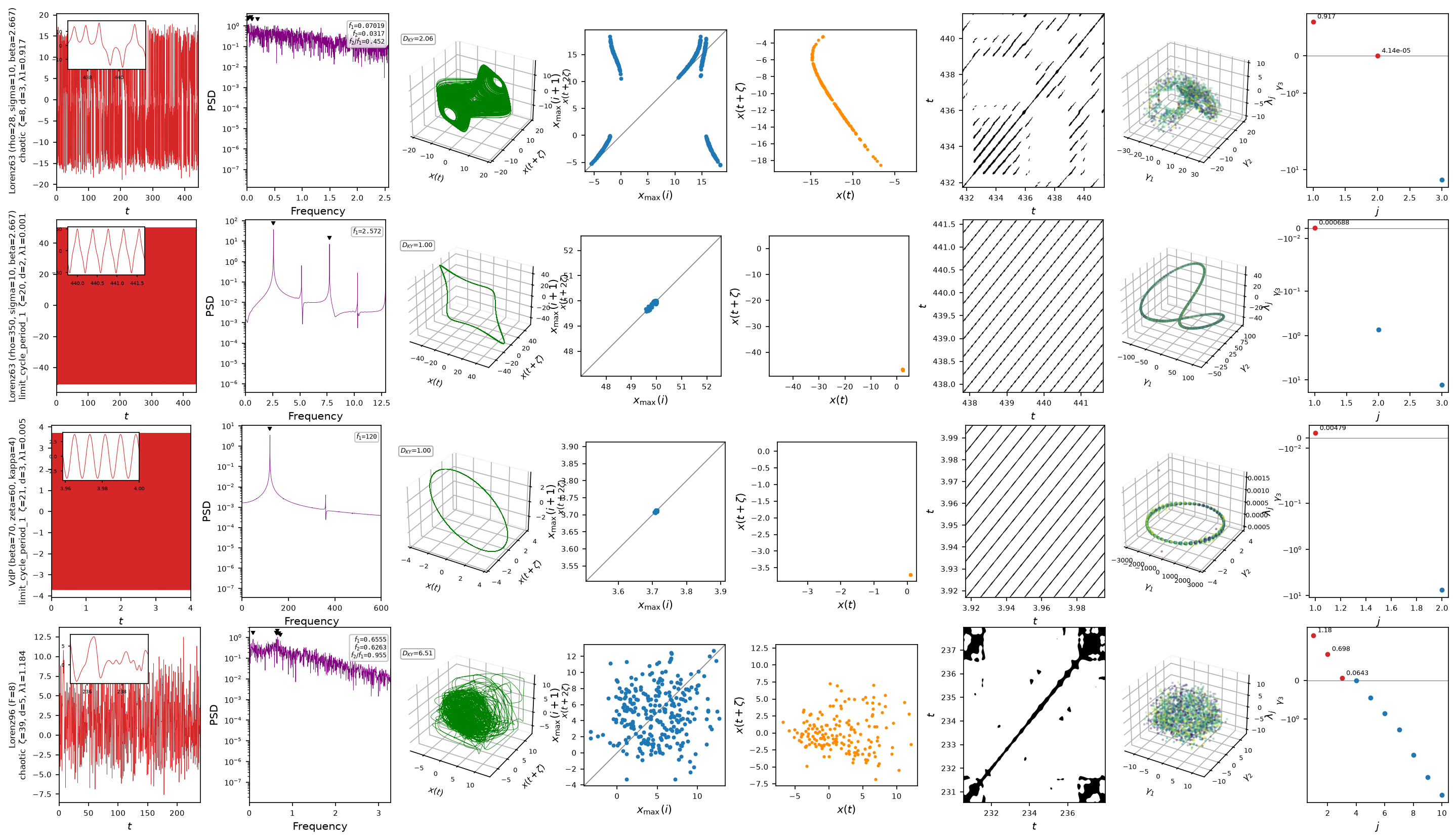
Demo output (python -m ntsa.characterize): Lorenz63 chaotic and period-1, Van der Pol, Lorenz96.
The same pipeline runs from data alone — a measured scalar record plus,
optionally, state snapshots for the MDS panel, no model equations: embedding,
\(D_2\), a Rosenstein leading-exponent estimate, and the regime label
(ntsa.data).

Snapshot-only route (ntsa.data.DataSeries): the Lorenz63 case re-characterized
without the model — \(\lambda_1 = 0.97 \pm 0.06\) (true 0.906), classified chaotic.
Ecosystem
dynamodels— the reference Model implementation (physical models used by the demos and tests).- romda — real-time bias-aware data assimilation built on both packages.
Citation
If you use this repository, please cite the software archive:
@software{novoa_ntsa,
  author = {Nóvoa},
  title = {ntsa: nonlinear time-series analysis for dynamical-system models},
  publisher = {Zenodo},
  doi = {10.5281/zenodo.21840914},
  url = {https://doi.org/10.5281/zenodo.21840914},
}
The routines in this package were developed from the codes published as supplementary material of Nóvoa & Magri (2022):
@article{novoa2022jfm,
  title = {Real-time thermoacoustic data assimilation},
  journal = {Journal of Fluid Mechanics},
  volume = {948},
  pages = {A35},
  year = {2022},
  doi = {10.1017/jfm.2022.653},
  url = {https://doi.org/10.1017/jfm.2022.653},
  eprint = {2106.06409},
  archivePrefix = {arXiv},
  author = {Nóvoa and Magri},
}
References
- Kantz & Schreiber (2004). Nonlinear Time Series Analysis, 2nd ed., Cambridge Univ. Press.
- Kennel, Brown & Abarbanel (1992). Determining embedding dimension for phase-space reconstruction using a geometrical construction. Phys. Rev. A 45, 3403.
- Benettin, Galgani, Giorgilli & Strelcyn (1980). Lyapunov characteristic exponents for smooth dynamical systems and for Hamiltonian systems. Meccanica 15, 9–30.
- Rosenstein, Collins & De Luca (1993). A practical method for calculating largest Lyapunov exponents from small data sets. Physica D 65, 117–134.
- Ginelli, Poggi, Turchi, Chaté, Livi & Politi (2007). Characterizing dynamics with covariant Lyapunov vectors. Phys. Rev. Lett. 99, 130601.