Phase-space reconstruction
How coordinates for the attractor are obtained — from a scalar record (delay embedding, with its two free parameters) or from the full state trajectory (MDS).
Delay embedding (Takens)
The attractor is reconstructed from the scalar record by the delay map
which is an embedding (diffeomorphic to the true attractor) for
\(d > 2\,d_A\) with \(d_A\) the attractor's box-counting dimension [Takens 1981].
delay_embed(x, dim, lag) builds \(\mathbf{Y}\); the two free parameters are
chosen as follows.
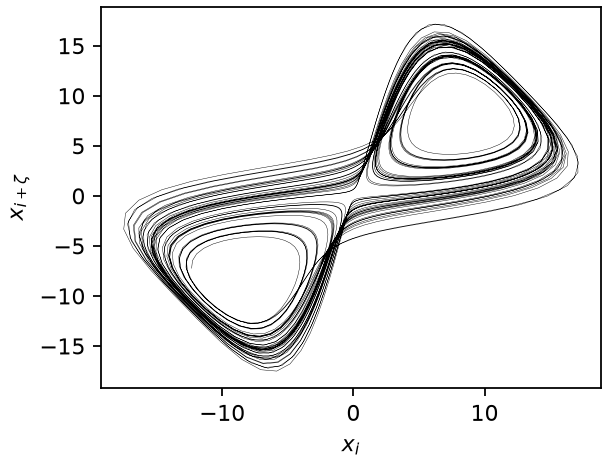
Two delay coordinates of chaotic Lorenz63 (\(\zeta = 8\) samples).
Optimal lag: average mutual information
The AMI between the signal and its \(\zeta\)-shifted copy,
is estimated on a histogram (\(p_k\): marginal bin probabilities, \(p_{kl}\):
joint probabilities of \(x_i\) falling in bin \(k\) and \(x_{i+\zeta}\) in bin \(l\)).
optimal_lag returns the first local minimum of \(I(\zeta)\) — the classic
compromise between independence (large \(I\) drop) and staying on the same
attractor fold [Fraser & Swinney 1986].
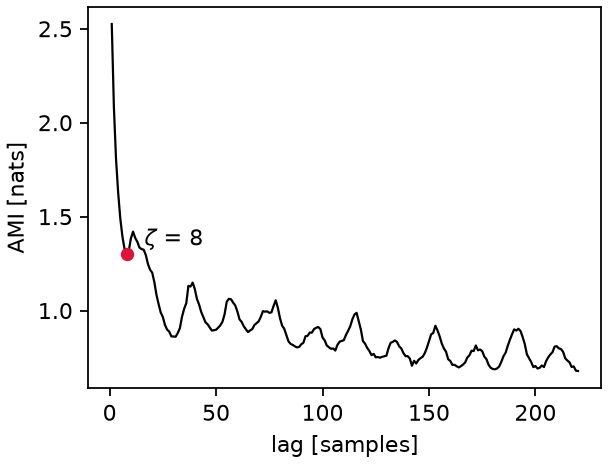
AMI of the Lorenz63 \(x\) record; the first local minimum sets \(\zeta = 8\).
Embedding dimension: false nearest neighbours
For each point \(\mathbf{Y}_i\) in dimension \(d\) with nearest neighbour \(\mathbf{Y}_{n(i)}\) at distance \(R_d(i)\), the neighbour is declared false if unfolding to \(d+1\) stretches it too much [Kennel et al. 1992]:
with \(R_\mathrm{tol} = 10\), \(A_\mathrm{tol} = 2\) and \(\sigma_x\) the signal's
standard deviation. false_nearest_neighbours returns the smallest \(d\) whose
false-neighbour fraction drops below 1%.
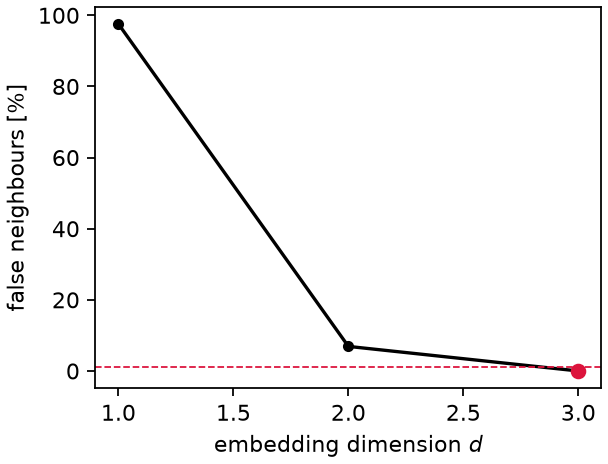
False-neighbour fraction for Lorenz63: below the 1% threshold (dashed) at \(d = 3\).
Embedding dimension: Cao's method
Cao (1997) replaces the distance threshold of false nearest neighbours by a ratio of averages. With \(n(i,d)\) the nearest neighbour of \(\mathbf{Y}_i\) in dimension \(d\) (maximum norm, outside the Theiler window \(\lvert i - n \rvert \le w\)),
where the superscript is the embedding dimension. \(E_1(d)\) stops changing once
\(d\) unfolds the attractor; cao_embedding_dimension returns the first \(d\) at
which successive values of \(E_1\) differ by less than tol. Because \(E_1\) also
saturates for random data, the second quantity
separates the two cases: \(E_2(d) \approx 1\) for every \(d\) when the series is stochastic, whereas a deterministic series has \(E_2(d) \ne 1\) at small \(d\). On high-dimensional chaos with a long delay, \(E_2\) approaches 1 as well, so a flat \(E_2\) is a necessary, not a sufficient, sign of noise.
Embedding dimension: Takens' bound
Takens' theorem guarantees an embedding for every \(d \ge 2D + 1\), so the minimum embedding dimension \(m_\mathrm{min}\), which Cao's method and false nearest neighbours estimate, satisfies
where the lower bound holds because the reconstruction must contain the
attractor. In Takens (1981), \(D\) is the dimension of the manifold that contains
the dynamics (Lorenz-63: \(D = 3\), bound 7); in Sauer, Yorke & Casdagli (1991),
\(D\) is the box-counting dimension of the attractor (Lorenz-63: \(D \approx 2.06\),
bound 5). takens_bound returns the bound for a given \(D\), or estimates \(D\) as
the correlation dimension \(D_2\) of the delay embedding when it receives the
series. The bound is a sufficient condition, so it typically exceeds the
minimum dimension found from the data.
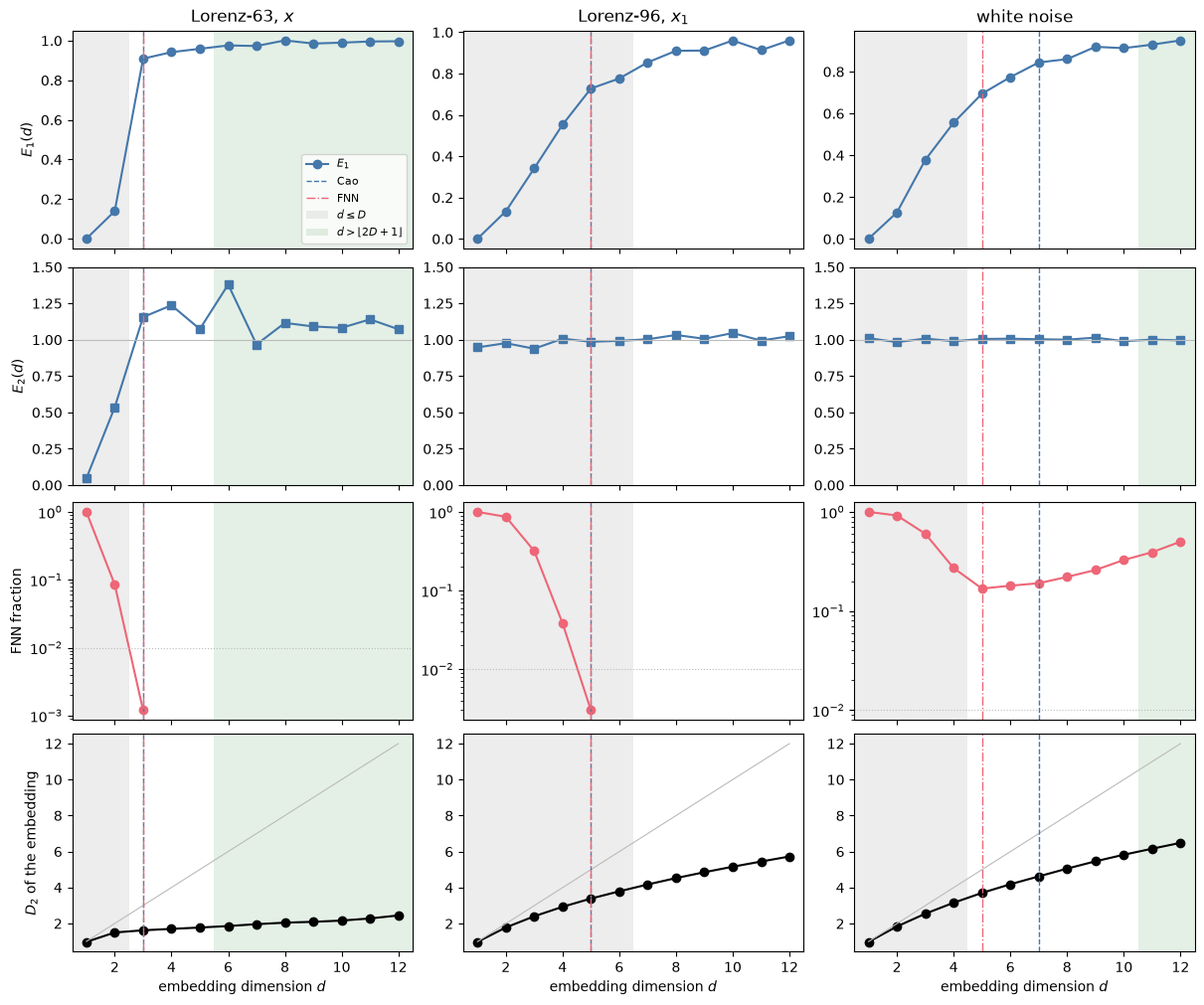
Columns: Lorenz-63 \(x\), Lorenz-96 \(x_1\) (\(N_x = 10\), \(F = 8\)) and white noise. Rows: \(E_1\), \(E_2\), the false-neighbour fraction and \(D_2\) of the delay embedding against \(d\). Dashed and dash-dotted lines mark the Cao and FNN estimates; grey shading marks \(d \le D\) and green shading \(d > \lfloor 2D+1 \rfloor\), with \(D = D_\mathrm{KY}\) for the Lorenz systems and \(D_2\) for noise. The comparison, including the dependence on series length and observation noise, is in the embedding-dimension tutorial.
Classical multidimensional scaling
From the pairwise distance matrix \(D_{ij}\) of the (subsampled) state trajectory, the Gram matrix is recovered by double centring,
where \(D^{(2)}\) holds squared distances. The embedding coordinates are \(\gamma_j = \sqrt{\mu_j}\, v_j\) from the top eigenpairs \((\mu_j, v_j)\) of \(B\) — a distance-preserving 3-D view of the attractor that requires no choice of observable.
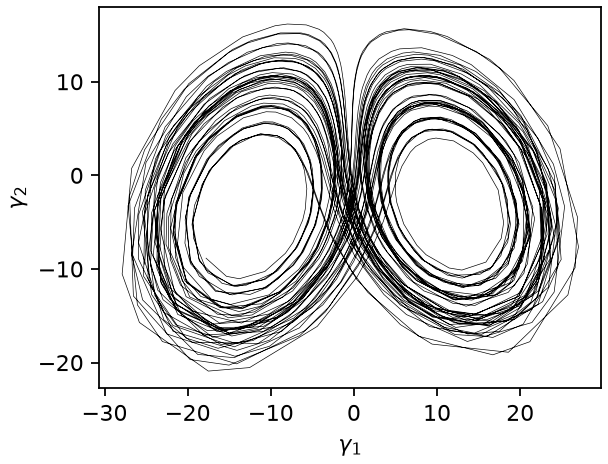
First two MDS coordinates \(\gamma_1, \gamma_2\) of the Lorenz63 state trajectory.
References are collected on the theory overview.