Estimators (data assimilation)
Summary
File: src/estimators/__init__.py
Abstract base class (ABC) that wraps a Model and an optional Bias into a full DA loop. Provides the shared forecast_step() that advances both the model and the bias in time.
Key attributes: est_phi, est_alpha, est_bias, inflation_factor, num_DA_blind, num_SE_only
Key concrete methods: forecast_step(), _init_bias(), _MA() (applies measurement operator M)
Subclasses must implement:
- analysis_step(d, Cdd) — Bayesian update given observation vector d and noise covariance Cdd
Estimator  (ABC)
├── EnsembleEstimator            → Stochastic filters
│   ├── EnKF
│   ├── EnSRKF
│   └── rBA_EnKF
└── DeterministicEstimator       → Deterministic filters
    └── KalmanFilter
The relationship between the three main classes — attributes, not subclasses:
Estimator instance
  .model  →  Model instance   (used for the forecast)
  .bias   →  Bias instance    (optional; None if bias-unaware)
             .forecaster  →  Model instance   (usually an ESN_model)
See Stochastic filters and Deterministic filters for the concrete implementations.
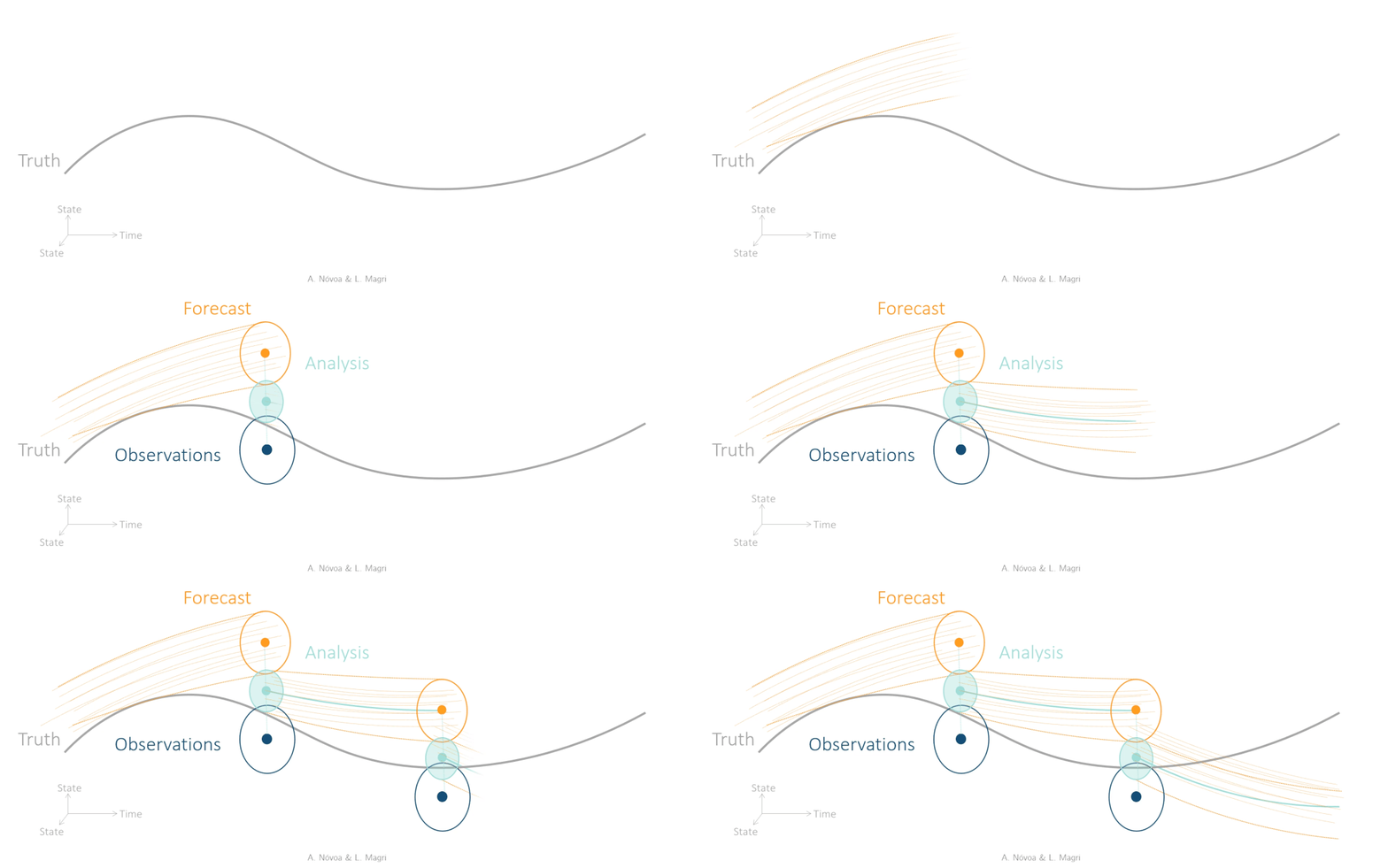
romda.estimators.Estimator(**kwargs)

Bases: ABC
Abstract base class shared by all state/parameter estimators.
Every concrete estimator (EnKF, EnSRKF, rBA_EnKF, KalmanFilter, ...)
owns a Model instance for the forecast step and, optionally, a
Bias instance for bias-aware assimilation. The observation operator maps state
to observation space, \(\mathbf{y} = \mathbf{M}\boldsymbol{\psi}\) if \(\mathbf{M}\)
is a matrix, or \(\mathbf{y} = \mathbf{M}(\boldsymbol{\psi})\) if \(\mathbf{M}\) is
callable; if not supplied explicitly it is read from model.M.
Subclasses must implement analysis_step(d, Cdd, **kwargs): the Bayesian update
given observation \(\mathbf{d}\) and observation-noise covariance \(\mathbf{C}_{dd}\).
Implementations build the forecast state internally, run the filter update,
validate the result, and update the model history in-place.
Notation
| Symbol | Meaning | Shape |
|---|---|---|
| \(N\) | augmented state dimension (\(N_\phi{+}N_\alpha\), or \(+N_q\) once observables are appended) | |
| \(N_\phi\) | model state dimension | |
| \(N_\alpha\) | number of estimated parameters | |
| \(N_q\) | number of observables | |
| \(m\) | ensemble size | |
| \(\boldsymbol{\psi}\) | state vector / ensemble | \((N,)\) or \((N, m)\) |
| \(\mathbf{M}\) | measurement operator (matrix or callable) | \((N_q, N)\) |
| \(\mathbf{d}\) | observation vector | \((N_q,)\) |
| \(\mathbf{C}_{dd}\) | observation-noise covariance | \((N_q, N_q)\) |
| \(\mathbf{C}_{\psi\psi}\) | forecast (prior) covariance | \((N, N)\) |
| \(\mathbf{K}\) | Kalman gain | \((N, N_q)\) |
Attributes:
| Name | Type | Description |
|---|---|---|
est_phi |
bool
|
Whether to estimate the model state (default True). |
est_alpha |
list of str
|
Names of model parameters to estimate (default |
est_bias |
bool
|
Whether to estimate an observation bias (default False). |
start_param |
int
|
Analysis step at which parameter estimation starts; parameters are frozen in earlier analyses (0 = active from the first analysis). |
start_bias |
int
|
Analysis step at which a bias-aware filter starts its bias-aware update; a plain EnKF update is applied in earlier analyses (0 = active from the first analysis). |
inflation_factor |
float
|
Covariance/ensemble inflation factor (default 1.0). |
inflate_parameters |
bool
|
Whether the inflation also acts on the estimated parameters (default True). A parameter has no forecast dynamics, so an inflated parameter performs a random walk; False keeps the analysis spread of the parameters (their forecast spread after a rejected analysis). |
inflation_factor_rejection |
float
|
Inflation applied after a rejected analysis (default 1.002). |
results_folder |
str or None
|
Optional path for saving results. |
References
Kalman (1960). A new approach to linear filtering and prediction problems. J. Basic Eng., 82(1), 35-45.
Evensen (2009). Data Assimilation: The Ensemble Kalman Filter. Springer.
Nóvoa, Racca & Magri (2023). Inferring unknown unknowns: Regularized bias-aware ensemble Kalman filter. Comput. Methods Appl. Mech. Eng., 418, 116502.
Source code in src/estimators/base.py
124 125 126 127 128 129 130 131 132 133 134 135 136 137 138 139 140 141 | |
model
property

The Model instance used for the forecast step.
bias
property
writable

Bias instance, or None if not configured.
current_state
property

Current state (delegates to model).
current_time
property

Current time (delegates to model).
current_bias_estimate
property

Current bias estimate, or None if no bias model.
Nphi
property

Size of the model state vector.
Nq
property

Number of observable dimensions.
is_bias_aware
property

True when the estimator carries an explicit bias correction.
assimilated_data
property
writable

Namedtuple with fields data and times of all assimilated obs.
update_history(psi, t=None, b=None, modify_saved_states=False, reset=False)

Update model (and bias) history.
Source code in src/estimators/base.py
250 251 252 253 254 255 256 257 258 259 260 261 262 263 | |
forecast_step(t_end=None, reset=False, close=False, output_forecast=False, **kwargs)

Advance model (and bias, if present) in time.
Parameters:
| Name | Type | Description | Default |
|---|---|---|---|
t_end
|
float
|
Target time; Nt is derived from it if provided. |
None
|
reset
|
bool
|
Whether to reset model history on update. |
False
|
close
|
bool
|
Close the integrator after stepping. |
False
|
output_forecast
|
bool
|
If True, return the raw forecast array. |
False
|
Returns:
| Type | Description |
|---|---|
ndarray or None
|
|
Source code in src/estimators/base.py
308 309 310 311 312 313 314 315 316 317 318 319 320 321 322 323 324 325 326 327 328 329 330 331 332 333 334 335 336 337 338 339 340 341 342 343 344 345 346 347 348 349 350 351 352 353 354 355 356 357 358 359 360 361 362 363 364 365 366 367 368 369 370 371 372 373 374 375 376 | |
analysis_step(d, Cdd, return_analysis=False)
abstractmethod

Perform the Bayesian analysis step given observation d.
Implementations are responsible for building the augmented forecast
state, running the filter update, validating the result, and updating
the model history in-place. Optionally return the analysed state when
return_analysis=True.
Source code in src/estimators/base.py
424 425 426 427 428 429 430 431 432 433 434 435 436 437 | |