Skip to content

POD-ESN model

POD_ESN combines Proper Orthogonal Decomposition with an Echo State Network. It provides a reduced-order forecast model for high-dimensional fields, with sensor placement available through the projector interface.

romda.models.data_driven.pod_esn.POD_ESN(data, dt, plot_case=False, pdf_file=None, skip_sensor_placement=False, train_ESN=True, domain_of_measurement=None, down_sample_measurement=None, **kwargs)

Bases: ESN_model, POD

POD-projected echo state network: a POD decomposition reduces the (spatial) field to a handful of temporal coefficients, and an ESN_model is trained to forecast those coefficients in time.

Following the POD convention (see its docstring), writing \(\mathbf{Q} = \mathbf{X} - \bar{\mathbf{Q}}\) for the zero-mean data, the field is approximated as

\[ \mathbf{X} \approx \boldsymbol{\Psi}\boldsymbol{\Phi} + \bar{\mathbf{Q}}, \]

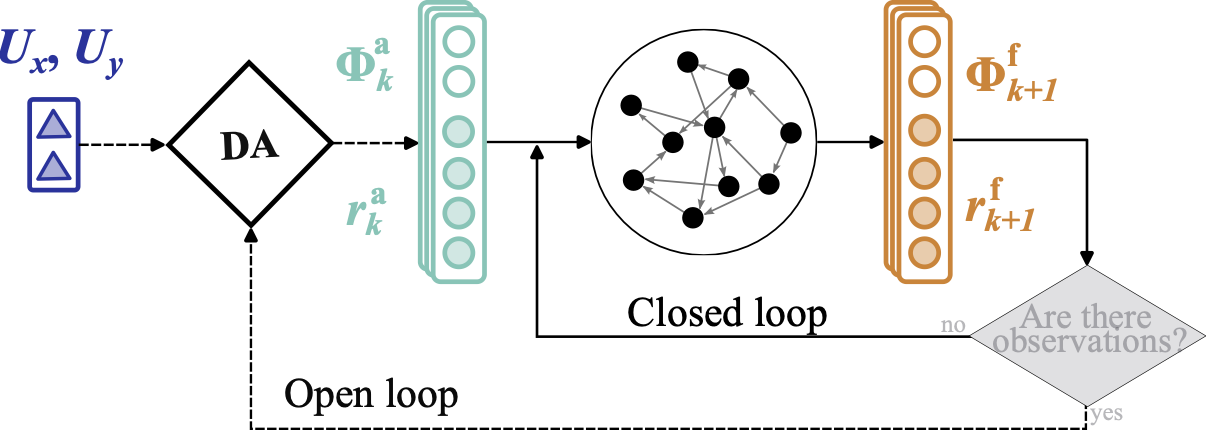
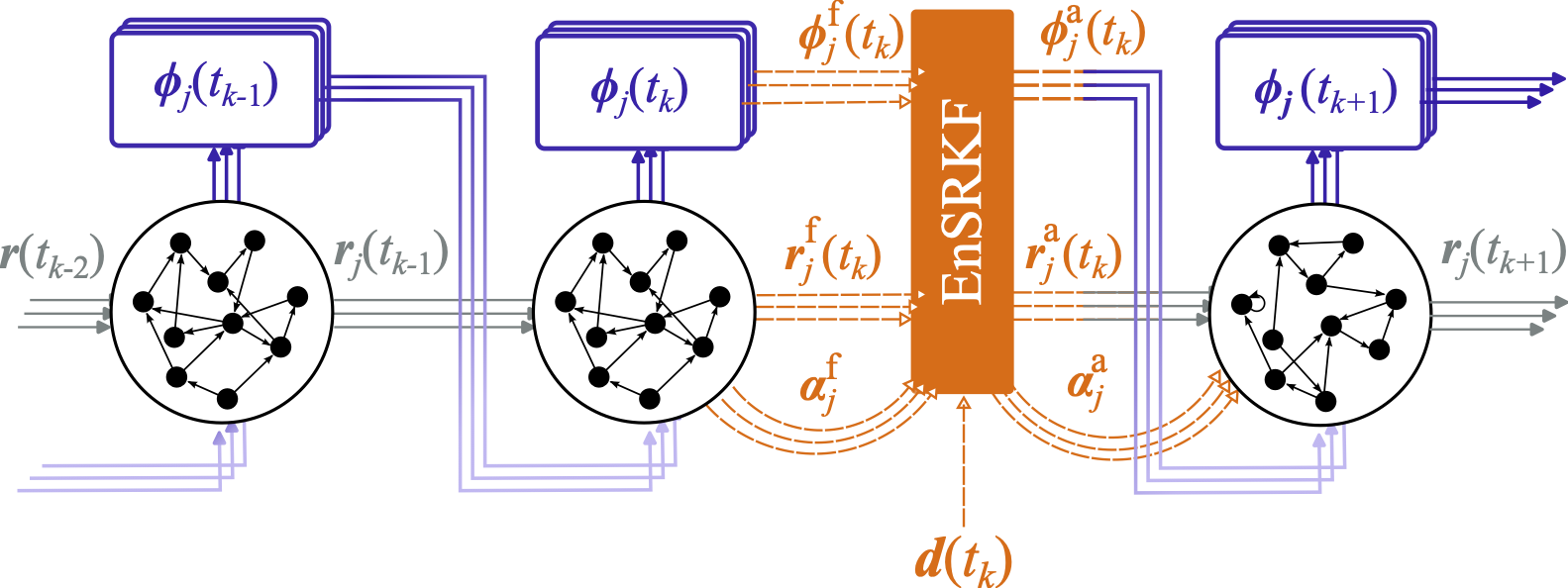
with \(\boldsymbol{\Psi}\) (Psi) the orthonormal spatial modes and \(\boldsymbol{\Phi}\) (Phi) the temporal coefficients (\(\boldsymbol{\Phi} = \boldsymbol{\Psi}^\mathrm{T}\mathbf{Q}\), already scaled by the singular values Sigma). POD_ESN.__init__ runs the POD decomposition first, then trains the ESN on \(\boldsymbol{\Phi}\) (transposed to the (L, Nt, N_modes) layout ESN_model expects) to forecast the temporal coefficients forward in time; get_observables maps the ESN's closed-loop Phi forecast back to physical sensor readings (decode) or returns the modal coefficients directly if measure_modes.

Run the POD decomposition, train the ESN on the resulting temporal coefficients, and select sensor locations for observation.

Parameters:

Name Type Description Default
data ndarray

Data for the POD decomposition and ESN training, shape (Nu, Nt, Nx, Ny) or (Nt, Ndim*Nx*Ny).

required
dt float

Time step of data; forwarded to ESN_model.__init__.

required
plot_case bool

Whether to plot the POD modes/spectrum/reconstruction (and the ESN training process, if train_ESN). Default False.

False
pdf_file str

If given (and plot_case), save the resulting figures to f'{pdf_file}.pdf'.

None
skip_sensor_placement bool

If True, skip sensor placement and observe the POD modes directly (equivalent to measure_modes). Default False.

False
train_ESN bool

Whether to train the ESN on the POD temporal coefficients. Default True.

True
domain_of_measurement list

Sub-domain [x0, x1, y0, y1] to restrict candidate sensor locations to, if sensor_locations is not already given. Defaults to domain.

None
down_sample_measurement int or (int, int)

Grid down-sampling factor(s) applied to the measurement domain before sensor selection.

None
**kwargs

Additional keyword arguments to configure the parent Model/ESN/POD classes, e.g. domain (physical domain of the data), grid_shape, Nq (number of sensors), sensor_locations, N_modes, t_train, t_val, N_units, etc.

{}
Source code in src/models/data_driven/pod_esn.py
 70
 71
 72
 73
 74
 75
 76
 77
 78
 79
 80
 81
 82
 83
 84
 85
 86
 87
 88
 89
 90
 91
 92
 93
 94
 95
 96
 97
 98
 99
100
101
102
103
104
105
106
107
108
109
110
111
112
113
114
115
116
117
118
119
120
121
122
123
124
125
126
127
128
129
130
131
132
133
134
135
136
137
138
139
140
141
142
143
144
145
146
147
148
149
150
151
152
153
154
155
156
157
158
159
160
161
162
163
164
165
166
def __init__(self,
             data,
             dt,
             plot_case=False,
             pdf_file=None,
             skip_sensor_placement=False,
             train_ESN=True,
             domain_of_measurement=None,
             down_sample_measurement=None,
             **kwargs):
    """Run the POD decomposition, train the ESN on the resulting temporal
    coefficients, and select sensor locations for observation.

    Parameters
    ----------
    data : np.ndarray
        Data for the POD decomposition and ESN training, shape
        ``(Nu, Nt, Nx, Ny)`` or ``(Nt, Ndim*Nx*Ny)``.
    dt : float
        Time step of `data`; forwarded to `ESN_model.__init__`.
    plot_case : bool
        Whether to plot the POD modes/spectrum/reconstruction (and the ESN
        training process, if `train_ESN`). Default False.
    pdf_file : str, optional
        If given (and `plot_case`), save the resulting figures to
        ``f'{pdf_file}.pdf'``.
    skip_sensor_placement : bool
        If True, skip sensor placement and observe the POD modes directly
        (equivalent to `measure_modes`). Default False.
    train_ESN : bool
        Whether to train the ESN on the POD temporal coefficients. Default True.
    domain_of_measurement : list, optional
        Sub-domain ``[x0, x1, y0, y1]`` to restrict candidate sensor locations
        to, if `sensor_locations` is not already given. Defaults to `domain`.
    down_sample_measurement : int or (int, int), optional
        Grid down-sampling factor(s) applied to the measurement domain before
        sensor selection.
    **kwargs
        Additional keyword arguments to configure the parent Model/ESN/POD
        classes, e.g. ``domain`` (physical domain of the data), ``grid_shape``,
        ``Nq`` (number of sensors), ``sensor_locations``, ``N_modes``,
        ``t_train``, ``t_val``, ``N_units``, etc.
    """

    for key in list(kwargs.keys()):
        if key in vars(POD_ESN):
            setattr(self, key, kwargs.pop(key))

    # __________________________ Init POD ___________________________ #
    POD.__init__(self,
                 X=data,
                 **kwargs)  # Initialize POD class and run decomposition

    # __________________________ Init ESN ___________________________ #
    # Initialize ESN to forecast the POD coefficients
    if train_ESN:
        ESN_model.__init__(self,
                           data=phi_to_esn_layout(self.Phi.copy()),
                           dt = dt,
                           plot_training=plot_case,
                           **kwargs)

    # __________________________ Select sensors ___________________________ #
    if self.measure_modes or skip_sensor_placement:
        self.Nq = self.N_modes
    elif self.sensor_locations is None:
        self.domain_of_measurement = domain_of_measurement
        self.down_sample_measurement = down_sample_measurement
        self.sensor_locations = self.define_sensors(N_sensors=self.Nq)
        self.Nq = len(self.sensor_locations)
    else:
        # If the sensors are already defined, use them
        self.Nq = len(self.sensor_locations)


    if plot_case:
        rec = self.reconstruct(X=data[:, -1])
        rec = self._to_physical_grid(rec)
        err = np.sqrt((rec - data[:, -1])**2) / np.nanmax(data[:, -1]**2)
        datasets={'Input': data[:, -1],
                  f'POD {self.N_modes} modes': rec,
                  'Error': err}

        POD_ESN.plot_case(case=self, num_modes=self.N_modes, datasets=datasets)


        if pdf_file is not None:
            self.pdf_file = pdf_file
            if isinstance(self.pdf_file, str):
                self.pdf_file = plt_pdf.PdfPages(f'{self.pdf_file}.pdf')

            figs = [plt.figure(ii) for ii in plt.get_fignums()]
            for fig in figs:
                add_pdf_page(self.pdf_file, fig_to_add=fig, close_figs=True)


    print('========= POD-ESN model complete =========')

obs_labels property

list of str: LaTeX labels for the observed quantities -- POD coefficients \(\Phi_1, \dots, \Phi_{N_\mathrm{modes}}\) if measure_modes, otherwise the sensor readings' \(u_x\)/\(u_y\) components.

state_labels property

list of str: LaTeX labels for the state vector, \(\Phi_1, \dots, \Phi_{N_\mathrm{modes}}\) (POD temporal coefficients, if update_state) followed by \(r_1, \dots, r_{N_\mathrm{units}}\) (reservoir units, if update_reservoir).

N_sensors property

int: Number of sensor locations per velocity component (\(u_x\) or \(u_y\)), i.e. Nq // 2 (each location contributes 2 observables); 0 if measure_modes.

sensor_rows property

np.ndarray or None: Rows of Psi/Q_mean corresponding to sensor_locations (cached after first access; invalidated by select_sensors). sensor_locations are raw-grid indices (var * Nx * Ny + g), whereas the POD basis rows follow the masked flat ordering -- this property maps between the two, via grid_index_to_flat_rows. None if sensor_locations is None.

domain_of_measurement property writable

list: Sub-domain [x0, x1, y0, y1] sensors may be placed in. Defaults to the full domain if never set.

down_sample_measurement property writable

list of int or None: Grid down-sampling factors [step_x, step_y] applied to the measurement grid before sensor placement. None (no down-sampling) if never set.

grid_of_measurement property

np.ndarray: Flat-grid indices (fluid cells only, all velocity components) eligible for sensor placement, i.e. domain_of_measurement down-sampled by down_sample_measurement and intersected with fluid_mask_flat.

Raises:

Type Description
ValueError

If domain_of_measurement does not overlap the model domain.

get_POD_coefficients(Nt=1)

Read the forecasted POD temporal coefficients off the state history.

Parameters:

Name Type Description Default
Nt int

Number of trailing history steps to return. Default 1.

1

Returns:

Type Description
ndarray

\(\boldsymbol{\Phi}\)-block of hist, shape (N_modes, m) if Nt == 1 else (Nt, N_modes, m).

Source code in src/models/data_driven/pod_esn.py
221
222
223
224
225
226
227
228
229
230
231
232
233
234
235
236
237
238
239
def get_POD_coefficients(self, Nt=1):
    r"""Read the forecasted POD temporal coefficients off the state history.

    Parameters
    ----------
    Nt : int
        Number of trailing history steps to return. Default 1.

    Returns
    -------
    np.ndarray
        $\boldsymbol{\Phi}$-block of `hist`, shape ``(N_modes, m)`` if
        ``Nt == 1`` else ``(Nt, N_modes, m)``.
    """
    if Nt == 1:
        Phi = self.hist[-1, :self.N_modes]
    else:
        Phi = self.hist[-Nt:, :self.N_modes]
    return Phi

get_observables(Nt=1, Phi=None, **kwargs)

Map the (forecasted) POD coefficients to observables: the coefficients themselves if measure_modes, otherwise physical-space sensor readings obtained via decode at sensor_rows.

Parameters:

Name Type Description Default
Nt int

Number of trailing history steps to return. Default 1.

1
Phi ndarray

POD coefficients to decode, shape (N_modes, Nt, m). Defaults to get_POD_coefficients(Nt).

None
**kwargs

Unused; accepted for interface compatibility.

{}

Returns:

Type Description
ndarray

Observables, shape (Nq, m) (or (Nt, Nq, m) for the reshaped case).

Source code in src/models/data_driven/pod_esn.py
241
242
243
244
245
246
247
248
249
250
251
252
253
254
255
256
257
258
259
260
261
262
263
264
265
266
267
268
269
270
271
272
273
274
275
276
277
278
279
280
def get_observables(self, Nt=1, Phi=None, **kwargs):
    """Map the (forecasted) POD coefficients to observables: the coefficients
    themselves if `measure_modes`, otherwise physical-space sensor readings
    obtained via `decode` at `sensor_rows`.

    Parameters
    ----------
    Nt : int
        Number of trailing history steps to return. Default 1.
    Phi : np.ndarray, optional
        POD coefficients to decode, shape ``(N_modes, Nt, m)``. Defaults to
        `get_POD_coefficients(Nt)`.
    **kwargs
        Unused; accepted for interface compatibility.

    Returns
    -------
    np.ndarray
        Observables, shape ``(Nq, m)`` (or ``(Nt, Nq, m)`` for the reshaped case).
    """
    if self.measure_modes:
        obs = self.get_POD_coefficients(Nt=Nt)
    else:
        if Phi is None:
            Phi = self.get_POD_coefficients(Nt=Nt) # Nt x N_modes x Ndim

        og_shape = Phi.shape
        reshape = Phi.ndim == 3
        if reshape:
            Phi = Phi.transpose(1, 0, 2)  # N_modes x Nt x Ndim
            Phi = Phi.reshape(self.N_modes, -1)  # N_modes x Nt*Ndim

        obs = self.decode(Z=Phi, idx=self.sensor_rows) #shape (N, Nt*Ndim)

        if reshape:
            obs = obs.reshape(self.Nq, og_shape[0], og_shape[2])  # Nq x Nt x Ndim
            obs = obs.transpose(1, 0, 2)  # Nt x Nq x Ndim


    return obs # Nt x Nq x m

reset_case(reset_POD=False, reset_ESN=False, Phi0=None, **kwargs)

Optionally rerun the POD decomposition and/or reset (retrain) the ESN.

Parameters:

Name Type Description Default
reset_POD bool

If True, rerun the POD decomposition (rerun_POD_decomposition) and force reset_ESN to True (since the modes it forecasts change). Default False.

False
reset_ESN bool

If True, reset the EchoStateNetwork/Model state via reset_ESN (ESN_model.reset_ESN). Default False.

False
Phi0 ndarray

Passed to reset_ESN as psi0 (defaults to Phi[0]); note reset_ESN itself recomputes psi0 from the freshly trained network before resetting the model, so this value is not the final initial state.

None
**kwargs

Forwarded to rerun_POD_decomposition and/or reset_ESN.

{}

Returns:

Type Description
None
Source code in src/models/data_driven/pod_esn.py
282
283
284
285
286
287
288
289
290
291
292
293
294
295
296
297
298
299
300
301
302
303
304
305
306
307
308
309
310
311
312
def reset_case(self, reset_POD=False, reset_ESN=False, Phi0=None, **kwargs):
    """Optionally rerun the POD decomposition and/or reset (retrain) the ESN.

    Parameters
    ----------
    reset_POD : bool
        If True, rerun the POD decomposition (`rerun_POD_decomposition`) and
        force `reset_ESN` to True (since the modes it forecasts change).
        Default False.
    reset_ESN : bool
        If True, reset the `EchoStateNetwork`/`Model` state via `reset_ESN`
        (`ESN_model.reset_ESN`). Default False.
    Phi0 : np.ndarray, optional
        Passed to `reset_ESN` as ``psi0`` (defaults to `Phi[0]`); note
        `reset_ESN` itself recomputes ``psi0`` from the freshly trained network
        before resetting the model, so this value is not the final initial state.
    **kwargs
        Forwarded to `rerun_POD_decomposition` and/or `reset_ESN`.

    Returns
    -------
    None
    """
    if reset_POD:
        self.rerun_POD_decomposition(**kwargs)
        reset_ESN = True  # The ESN must be reset to account for the change in POD modes

    if reset_ESN:
        if Phi0 is None:
            Phi0 = self.Phi[0]
        self.reset_ESN(psi0=Phi0, **kwargs)

select_sensors(measure_modes=False, domain_of_measurement=None, down_sample_measurement=None, N_sensors=None, qr_selection=False)

(Re)configure how the model is observed: either the raw POD coefficients (measure_modes) or physical-space point sensors placed by define_sensors.

Parameters:

Name Type Description Default
measure_modes bool

If True, observe the POD coefficients directly (Nq = N_modes, no sensors). Default False.

False
domain_of_measurement list

Sub-domain [x0, x1, y0, y1] to restrict candidate sensor locations to. Defaults to domain.

None
down_sample_measurement int or (int, int)

Grid down-sampling factor(s) for the measurement domain.

None
N_sensors int

Number of sensor locations to place. Defaults to N_sensors.

None
qr_selection bool

Whether to use QR-pivoting sensor placement (define_sensors). Default False.

False

Returns:

Type Description
None

Sets measure_modes, sensor_locations and Nq in place.

Source code in src/models/data_driven/pod_esn.py
315
316
317
318
319
320
321
322
323
324
325
326
327
328
329
330
331
332
333
334
335
336
337
338
339
340
341
342
343
344
345
346
347
348
349
350
351
352
353
def select_sensors(self, measure_modes=False,
                  domain_of_measurement=None,
                  down_sample_measurement=None,
                  N_sensors=None, qr_selection=False):
    """(Re)configure how the model is observed: either the raw POD coefficients
    (`measure_modes`) or physical-space point sensors placed by `define_sensors`.

    Parameters
    ----------
    measure_modes : bool
        If True, observe the POD coefficients directly (`Nq = N_modes`, no
        sensors). Default False.
    domain_of_measurement : list, optional
        Sub-domain ``[x0, x1, y0, y1]`` to restrict candidate sensor locations
        to. Defaults to `domain`.
    down_sample_measurement : int or (int, int), optional
        Grid down-sampling factor(s) for the measurement domain.
    N_sensors : int, optional
        Number of sensor locations to place. Defaults to `N_sensors`.
    qr_selection : bool
        Whether to use QR-pivoting sensor placement (`define_sensors`).
        Default False.

    Returns
    -------
    None
        Sets `measure_modes`, `sensor_locations` and `Nq` in place.
    """
    self.measure_modes = measure_modes
    self._sensor_rows = None  # invalidate the cached Psi-row mapping
    if measure_modes:
        self.Nq = self.N_modes
        self.sensor_locations = None
    else:
        self.domain_of_measurement = domain_of_measurement
        self.down_sample_measurement = down_sample_measurement
        self.qr_selection = qr_selection
        self.sensor_locations = self.define_sensors(N_sensors=N_sensors)
        self.Nq = len(self.sensor_locations)

define_sensors(N_sensors=None, plot=False)

Choose sensor grid locations within grid_of_measurement.

If qr_selection, uses column-pivoted QR on the (physical-grid) spatial modes Psi restricted to the candidate locations, so the chosen sensors best condition the mode-reconstruction problem (a greedy, deterministic sensor-placement heuristic); otherwise picks N_sensors random locations (rng).

Parameters:

Name Type Description Default
N_sensors int

Number of sensor locations to place. Defaults to N_sensors.

None
plot bool

Show the debug scatter of grid/measurement domain/sensors (blocks in interactive backends). Default False.

False

Returns:

Type Description
ndarray

Flat-grid sensor indices, one block per velocity component, shape (grid_shape[0] * N_sensors,).

Source code in src/models/data_driven/pod_esn.py
451
452
453
454
455
456
457
458
459
460
461
462
463
464
465
466
467
468
469
470
471
472
473
474
475
476
477
478
479
480
481
482
483
484
485
486
487
488
489
490
491
492
493
494
495
496
497
498
499
500
501
502
503
504
505
506
507
508
509
510
511
512
513
514
515
516
517
518
519
520
521
522
523
524
525
526
527
528
529
530
531
532
533
534
535
536
537
538
539
540
541
542
543
544
545
def define_sensors(self, N_sensors=None, plot=False):
    """Choose sensor grid locations within `grid_of_measurement`.

    If `qr_selection`, uses column-pivoted QR on the (physical-grid) spatial
    modes `Psi` restricted to the candidate locations, so the chosen sensors
    best condition the mode-reconstruction problem (a greedy, deterministic
    sensor-placement heuristic); otherwise picks `N_sensors` random locations
    (`rng`).

    Parameters
    ----------
    N_sensors : int, optional
        Number of sensor locations to place. Defaults to `N_sensors`.
    plot : bool, optional
        Show the debug scatter of grid/measurement domain/sensors (blocks in
        interactive backends). Default False.

    Returns
    -------
    np.ndarray
        Flat-grid sensor indices, one block per velocity component, shape
        ``(grid_shape[0] * N_sensors,)``.
    """
    # Define the measurement grid

    Nu, Nx, Ny = self.grid_shape
    measure_grid_idx = np.asarray(self.grid_of_measurement)

    one_dom = measure_grid_idx[measure_grid_idx < Nx * Ny]  # only the first variable (e.g., ux) for sensor placement


    if N_sensors is None:
        N_sensors = self.N_sensors


    if self.qr_selection:

        Psi = self._to_physical_grid(self.Psi).transpose(1, 0, 2, 3)  # (r, Nu, Nx, Ny)

        Psi = np.nan_to_num(Psi, nan=0.0)
        Psi = Psi.reshape(Psi.shape[0], Nu, Nx * Ny)

        # choose one variable block for placement, e.g. variable 0
        A = Psi.reshape(Psi.shape[0], -1)  # shape (n_candidates, r)
        A = A[:, measure_grid_idx].T # shape (r, n_candidates)


        if N_sensors > A.shape[1]:
            A = np.dot(A, A.T)  # shape (n_candidates, n_candidates)

        qr_idx = sla.qr(A.T, pivoting=True)[-1]

        sensor_idx = measure_grid_idx[qr_idx[:N_sensors]]
        sensor_idx = sensor_idx.ravel() % (Nx * Ny)  # only the first variable (e.g., ux) for sensor placement

        if np.unique(sensor_idx).size < N_sensors:
            print(f'Warning: QR selection returned {np.unique(sensor_idx).size} unique sensors, less than requested {N_sensors}.')
            sensor_idx = np.unique(sensor_idx)
            extra_needed = N_sensors - sensor_idx.size
            if extra_needed > 0:
                extra_sensor_idx = measure_grid_idx[qr_idx[N_sensors:N_sensors + extra_needed]]
                extra_sensor_idx = extra_sensor_idx.ravel() % (Nx * Ny)
                sensor_idx = np.concatenate([sensor_idx, extra_sensor_idx])
    else:
        if N_sensors < len(one_dom):
            sensor_idx = np.sort(self.rng.choice(one_dom, size=N_sensors, replace=False), axis=None)
        else:
            sensor_idx = one_dom.copy()

    if N_sensors > len(measure_grid_idx):
        print(f'Requested number of sensors {N_sensors} >= grid size in domain of measurement ({len(measure_grid_idx)})')


    if plot:
        #plot the sensors against the og grid and measurement grid for debugging
        plt.figure()
        # original grid
        x_idx, y_idx = np.unravel_index(np.arange(Nx*Ny), (Nx, Ny))
        plt.scatter(x_idx, y_idx, label='Original grid', alpha=0.01
                    )
        #measurement grid
        x_idx, y_idx = np.unravel_index(measure_grid_idx[:len(measure_grid_idx)//2], (Nx, Ny))
        plt.scatter(x_idx, y_idx, label='Measurement grid')

        #sensors
        x_idx, y_idx = np.unravel_index(sensor_idx, (Nx, Ny))
        plt.scatter(x_idx, y_idx, label='Sensors')
        plt.legend()
        plt.show()

    # sensors fro all u
    sensor_idx = [sensor_idx + Nx*Ny*i for i in range(self.grid_shape[0])]

    return np.array(sensor_idx).reshape((-1,))

plot_case(case, datasets=None, num_modes=None) staticmethod

Plot the POD modes, temporal coefficients, spectrum and (if datasets is given) flow/reconstruction/error fields with sensor locations overlaid.

Parameters:

Name Type Description Default
case POD_ESN

Instance to plot.

required
datasets dict

Named fields to pass to romda.plotting.pod.plot_flows_rms (e.g. {'Input': ..., 'Reconstruction': ..., 'Error': ...}).

None
num_modes int

Number of POD modes to show. Defaults to case.N_modes.

None

Returns:

Type Description
None
Source code in src/models/data_driven/pod_esn.py
550
551
552
553
554
555
556
557
558
559
560
561
562
563
564
565
566
567
568
569
570
571
572
573
574
575
576
577
578
579
580
581
@staticmethod
def plot_case(case, datasets: Optional[dict]=None, num_modes=None):
    """Plot the POD modes, temporal coefficients, spectrum and (if `datasets`
    is given) flow/reconstruction/error fields with sensor locations overlaid.

    Parameters
    ----------
    case : POD_ESN
        Instance to plot.
    datasets : dict, optional
        Named fields to pass to `romda.plotting.pod.plot_flows_rms` (e.g.
        ``{'Input': ..., 'Reconstruction': ..., 'Error': ...}``).
    num_modes : int, optional
        Number of POD modes to show. Defaults to `case.N_modes`.

    Returns
    -------
    None
    """
    from romda.plotting.pod import plot_flows_rms, plot_modes, plot_spectrum, plot_time_coefficients

    if num_modes is None:
        num_modes = case.N_modes

    plot_modes(case=case, num_modes=num_modes, cmap='viridis', n_col=2)
    plot_time_coefficients(case=case, num_modes=num_modes)
    plot_spectrum(case=case, max_mode=num_modes)


    if datasets is not None:
        display_sensors = case.sensor_locations is not None
        plot_flows_rms(case=case, datasets=datasets, display_sensors=display_sensors)

POD-ESN data assimilation pipeline

State estimation with a POD-ESN reduced-order model.

POD-ESN state and parameter estimation

Joint state and parameter estimation with a POD-ESN.